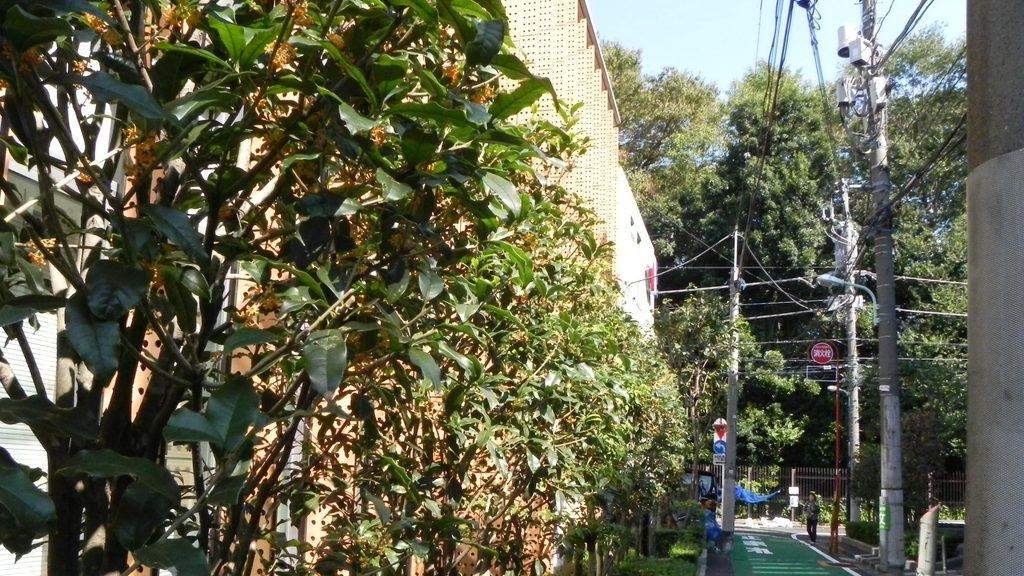
Until recently, the city still carried the scent of summer. Then one morning, I opened the window, and the air was alive with the fragrance of kinmokusei (sweet osmanthus).
I left home thinking they must have bloomed somewhere close, yet I experienced the same scent on neighboring streets, too. Even near my company, and even getting out of the station, I could sense their fragrance.
Almost overnight, kinmokusei had blossomed all across the city as though they’d arranged it with each other in advance.
I wonder who gave the signal.
Kinmokusei in the same area bloom at the same time because trees with similar traits respond to changes in temperature and sunlight.
Most of Japan’s kinmokusei are male trees and have been propagated by cuttings and similar such methods. When autumn comes, they open up at the same time across a wide area.
When Do Kinmokusei Bloom?
Kinmokusei generally bloom in late September to early October.
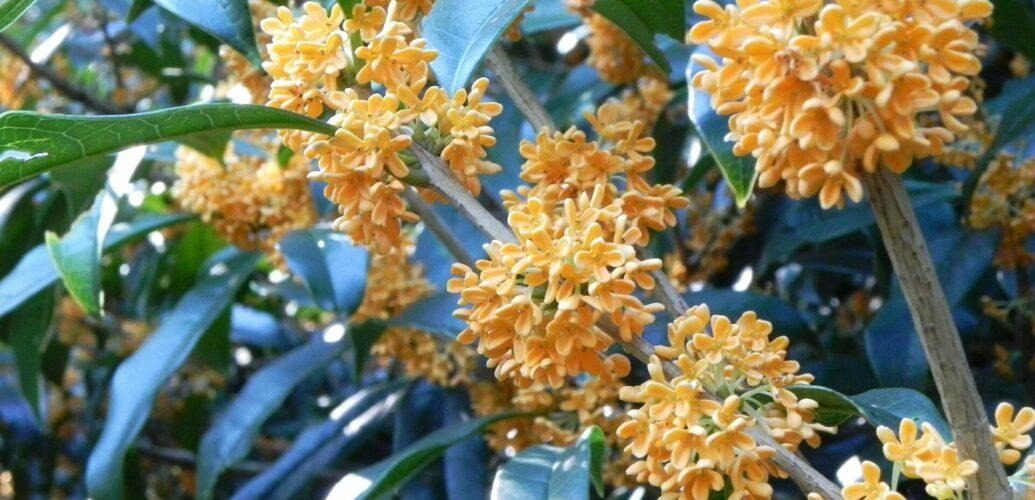
Small orange flowers blossom in clusters, filling their surroundings with a powerful aroma. But their peak is brief, and the blossoms fall within the space of a week.
Blossoming varies by region and the temperature of that particular year. Some years, you can sense them earlier, and other years, they don’t open until October. Sometimes they even bloom once again after falling and scattering.
Most Kinmokusei in Japan are Male
Kinmokusei is dioecious—male and female flowers grow on separate trees.
It seems only male trees were brought to Japan. They almost never bear fruit, so they cannot be propagated through seed. Their population is increased by human hand through cuttings, layering and other methods.
I wondered why Japan only has male trees.
Research finds that male trees carry more flowering nodes, with more flowers on each of them. Accordingly, the whole tree gives off a richer scent.
Perhaps the heavier-blooming male trees were chosen as garden trees, although no one can say the selection was male-only from the start.
Trees grown from seed inherit a little of both the father’s and the mother’s traits. Cuttings, on the other hand, stem from the branch of a parent tree; then new roots begin to shoot from the cutting.
Trees grown in this way inherit the same traits as the original.
This is how male trees have traditionally been propagated in Japan.
Responding to the Same Signal
There are other reasons why kinmokusei blossom simultaneously.
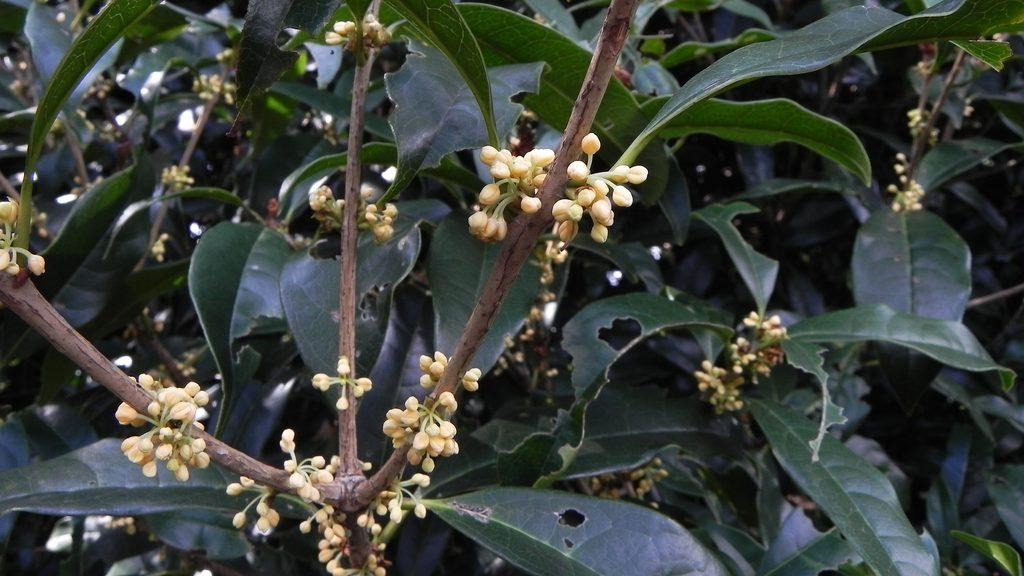
As summer gives way to autumn, kinmokusei bud and bloom in response to various weather conditions such as temperature, length of daylight, and strength of sunlight. The period in which they bud and bloom is relatively short.
Weather of a certain area will send the same signal to trees of a similar nature. That’s why the blooming season is simultaneous, rather than originating from a single tree.
This echoes the way in which cherry trees operate.
Someiyoshino cherry trees overcome the cold winter and bloom, triggered by the warmth of spring.
Cherry blossoms answer to their own conditions, as do kinmokusei.
Humans have had no hand in this. It is nature itself that made cherry blossom the harbingers of spring and kinmokusei the harbingers of autumn.
Blooming in unison has a power different to that of a single flower.
It anchors the seasons in memory.
A Scent with Limits
I had thought that people all over Japan were familiar with the scent of kinmokusei.
However, I heard that people who grew up in Hokkaido or Tohoku only experienced the fragrance of kinmokusei after coming to Tokyo.
Kinmokusei does not handle the cold well. So, as a garden tree, it’s popular mainly from the Kanto area westward. Although it is planted in the north as well, it is obviously not as widespread as it is in Tokyo.
I thought every Japanese person recognized kinmokusei as the scent of autumn. But climate has capped its popularity.
The Kinmokusei that Bloomed Three Times
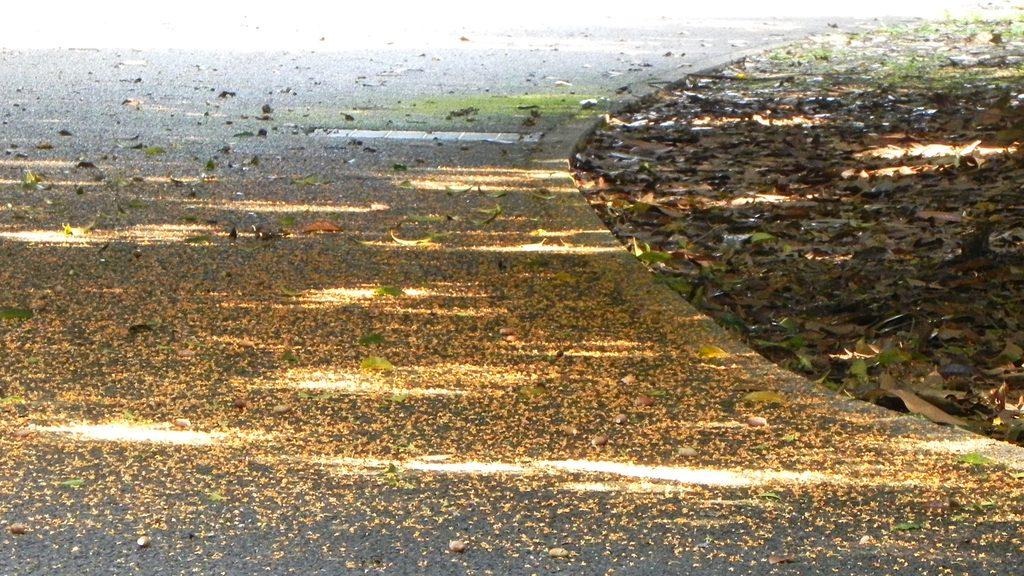
A few years ago, kinmokusei bloomed three times.
It bloomed, then scattered. After a while, it flourished again. I thought its cycle had ended for that year, until it blossomed a third time.
No matter how you look at it, blooming three times is unusual. But there is actual research where kinmokusei was grown in temperatures three degrees above normal.
Due to the heat, the trees bloomed later, the flowering period was longer, and blooming peaks appeared a second and even a third time.
A Pact Between Flowers and the Natural World
The blossoms look as if they bloom on a whim.
Some years they’re early. Some years they’re late. Just when you think they won’t bloom, they take us unawares. It’s a very human thing to comment on this kind of irregularity and expect blossoms to bloom like clockwork every year.
From the perspective of the kinmokusei, they’re just following the terms of the pact.
They feel the cold.
They accumulate the warmth.
The days grow shorter, the rain falls, and then it’s dry again.
Each tree has a delicate pact with the natural world, and when the conditions are met, it blooms exactly as it should.
We only see a small part of that pact.
So when the kinmokusei open up out of the blue, it is not the pact that has changed, but the conditions to which they are held.
And then one day, the air is alive with the heady aroma of many trees fulfilling their pact with nature all at once.
Perhaps I should try growing a sapling myself.
Author: Satori Osawa, Perfumer
Translation: Lynne Hobday
Kew Science – Plants of the World Online
Osmanthus fragrans Lour.
https://powo.science.kew.org/taxon/610878-1
Kew Science – Plants of the World Online
Osmanthus fragrans var. aurantiacus Makino
https://powo.science.kew.org/taxon/urn:lsid:ipni.org:names:77188571-1
SONNET—A Perfume that Captures the Scent of Kinmokusei
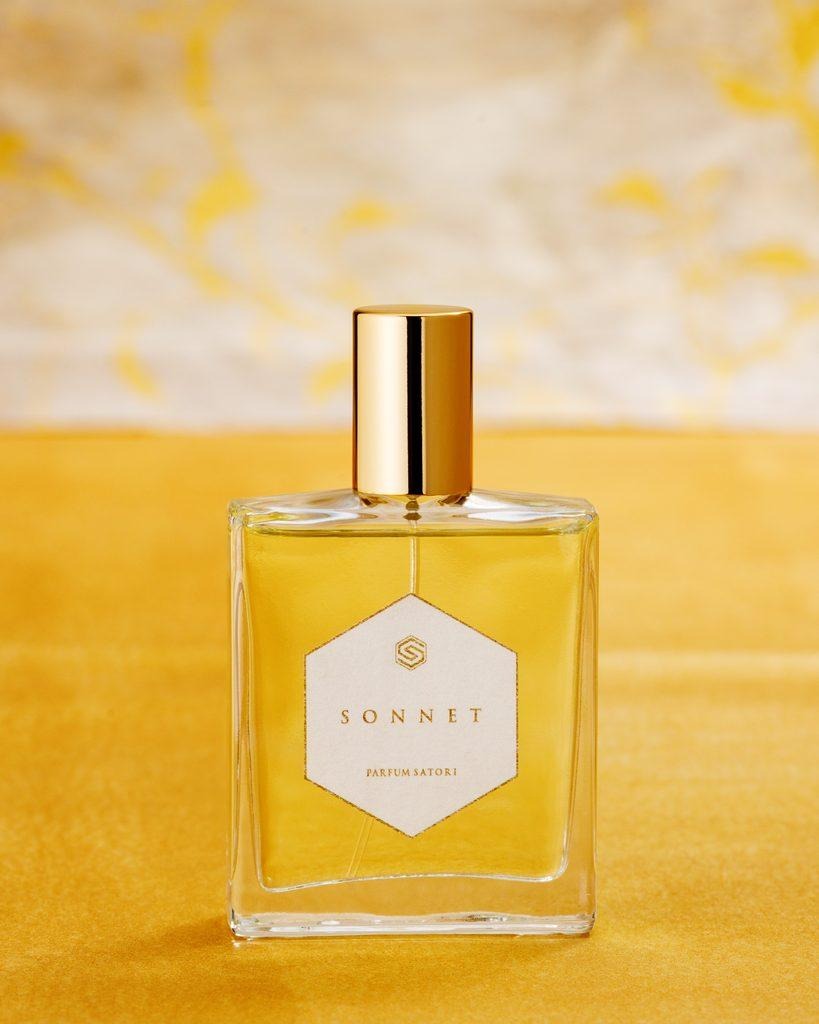
The Kinmokusei fragrance SONNET
Kew Science – Plants of the World Online
Osmanthus fragrans Lour.
https://powo.science.kew.org/taxon/610878-1
Kew Science – Plants of the World Online
Osmanthus fragrans var. aurantiacus Makino
https://powo.science.kew.org/taxon/urn:lsid:ipni.org:names:77188571-1