

Thermolysis and Sublimation:
An Exploration of Fragrance in Time and Space — Inspired by Agarwood
■ The Scent of Aromatic Wood and the Experience of Time
The quiet way in which aromatic woods —especially agarwood —release their fragrance somehow evokes the
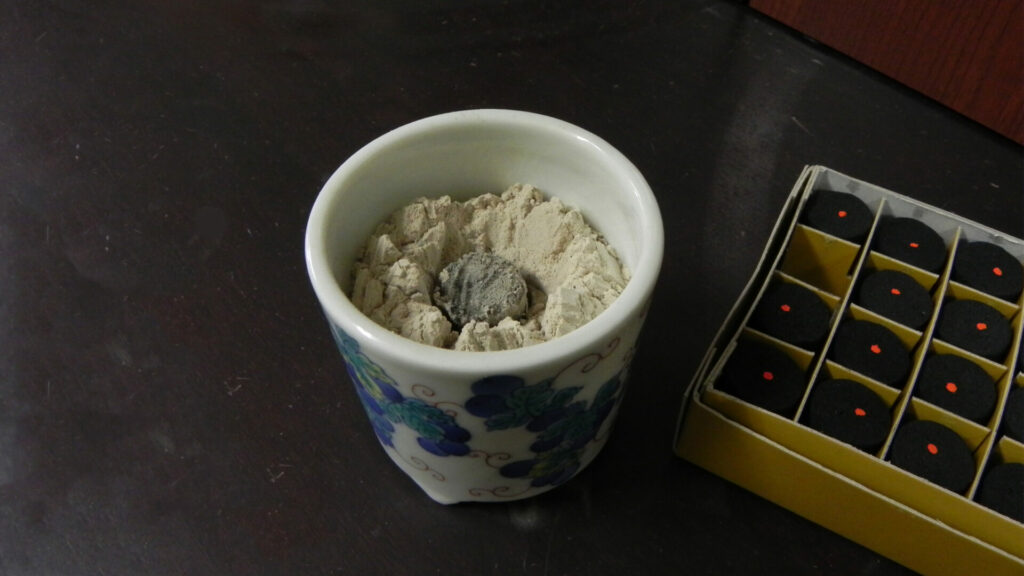
gentle flow of time. A small piece of charcoal in an incense burner, covered in ash,
transmits heat indirectly. Agarwood and kyara slowly release their exquisite aromas
without coming into contact with a naked flame.
The aroma does not explode from a single point, instead it drifts softly in line with the
temperature and humidity of the environment; it then circles the area around the
incense burner. It’s almost as if an invisible hemispherical dome gently manifests,
cradling the fragrance.
■ The Space Between Scents:
My Encounter with Kōdō (the Art of Incense Appreciation)
I vividly remember the moment in the kōdō classroom when I handled an incense
burner for the first time. Holding it gently in my left hand, I covered it softly with
my right hand, “listening” to the captured fragrance as it escaped through
the gaps in my fingers. Within that subtle movement, I could sense something
rising.
The fragrance never imposes itself. Rather, it serenely drifts, attuning itself to the
temperature of your hand and the quiet of your breathing. In kōdō, one “listens”
to a fragrance. But to me, it was like “observing” a fragrance manifesting as
a subtle shape.
■Thermolysis and Evaporation──How Aromatic Woods Produce their Scent
Scientifically speaking, the mechanism behind this involves a process known as
thermolysis. The resin components and agarwood acids contained within the
aromatic wood are chemically broken down by heat and are transformed into
a variety of compounds. After vaporization, these newly formed molecules
then vaporize, released into the air, ultimately reaching our noses.
In other words, the fragrance of aromatic woods comes about through a dual
process. New aromatic molecules are created through a chemical reaction,
and are then diffused into the surrounding environment through physical change.
■ The Diffusion of Perfume and a Contrasting Philosophy
Conversely, perfume operates on an entirely different principle. Conventional
fragrances are created by dissolving aromatic compounds in ethanol.
Ethanol is extremely volatile, and the moment it comes into contact with
human skin or air, the fragrance is propelled outward.
This is a major characteristic of perfume. A single spray of perfume
explodes into the environment. Whereas aromatic woods gradually release
their fragrance.
And this led me to thinking: although we apply perfume to the skin, could
we do not create something that releases its fragrance like aromatic wood?
Instead of a fragrance that disperses instantaneously, how about one
that lingers in the environment like a veil, enveloping and expanding?
A fragrance that softly evokes the gentle passage of time. Surely I could
come up with such a formula.
■Sublimating Aromatic Ingredients──Agarwood EssenceInfused into the Blend
Over time, this very question began to incorporate itself naturally into the perfumes
I was formulating. In hindsight, I realized―quite unconsciously―I had developed
a strong preference for a particular type of ingredient: not liquid oils, but fragrances
that present themselves as crystals, in solid form.
For example, borneol, coumarin, vanillin, heliotropin (piperonal), indole—
all are white, delicate crystals that slowly release their fragrance even at room
temperature.
This is due to a physical phenomenon called “sublimation,” where a solid
transitions directly into a gas without passing through a liquid state,
releasing its molecules into the air. This same phenomenon can be seen in
incense and camphor; it lends the fragrance a gentleness in its diffusion
and a lingering quality.

■From Intuition to Conviction──Insight and Reaffirmation in Perfumery
It was not until quite recently that I began to think: perhaps it’s the
properties of crystalline fragrance ingredients that have given my perfumes
a release that resembles that of aromatic woods. Thermolysis and
sublimation; although the mechanisms vary, the way in which fragrance
gently releases, and then lingers in the air, I feel there is a deep correlation
between the two.
The properties of these “sublimating fragrance ingredients” were something
I had learned from my perfumery teacher. He had given me a firm
basis for the choices I had already been making intuitively. Although my
approach had not changed, it was the moment when my instincts and actual
practiced aligned, and for that, I am deeply indebted to my teacher.
■ Perfume Emulating Agarwood──Fragrance that lingers rather than diffuses
An ethanol-based perfume that possesses the slow, deliberate release and
enveloping qualities of aromatic woods. For me to bring this into being, I would need
to restrain highly diffusive fragrance materials and instead make full
use of the “heaviness” and “retention” inherent in crystalline fragrance ingredients.
This is one approach to formulation rooted entirely in my own personal sensibility,
but even now it remains a way of thinking I deeply value when considering the
temporal existence of fragrance and its relationship to the environment.
The true gift of aromatic woods may not lie just in their fragrance, but in the poised
manner of their release and the intervals within them. I hope to carry this gift forward
with care, transforming it into a different medium of perfume.
Published by: PARFUM SATORI
Founder & Perfumer: Satori Osawa
References
- Iwanami Shinsho Editorial Board, “History of Japanese Thought”.
- Agency for Cultural Affairs, Japan Cultural Expo.
- Image credits: Unsplash / PARFUM SATORI.
Our Vision (Mission/Global Statement)